Thursday, January 7, 2016

Snowflakes


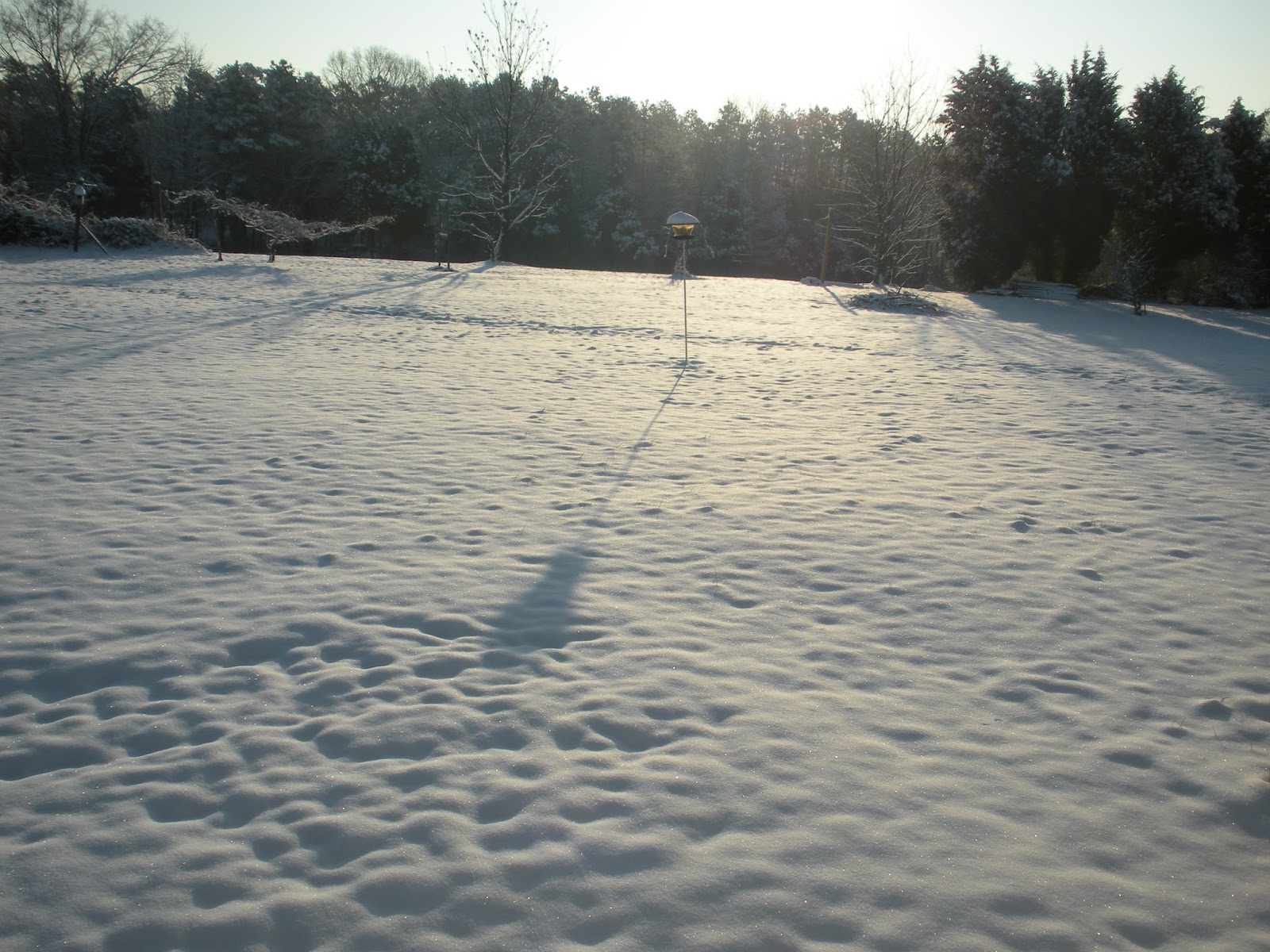
Many parts of the country have already been blanketed with snow, and it's a  possibility for many others. The first snowfall always seems a thing of wonder to me. I like to see the sun sparkle off the crystals, and a whitewashed world is just special. My husband was living in Missouri when we met. He said he never wanted to see another snowflake. However, after living in the South for over a dozen years now, he's saying he can't wait until the first snowfall. I just smile.


Snowflakes are actually frozen ice crystals, which are bounced around in the earth's atmosphere until they get heavy and fall to the ground. The conditions have to be just right to make this happen. They're really clear-colored, like ice, but they appear white because of the way the light is reflected.


Do you remember cutting out paper snowflakes? A snowflake always has six symmetrical sides. It is believed that no two snowflakes are alike, which is pretty amazing. If there have been repeats, it's been very rare. The largest snowflake ever recorded fell in Montana in 1887 and measured 15 inches across. Now that's a big snowflake!


_________________________________________


Wednesday, January 6, 2016

Hobby Month


January is National Hobby Month. Americans are pretty good at having hobbies. I would have a hard time naming all the ones I've ever had. Some of them are textile painting, cross-stitch, macrame, basket weaving, ceramics, crochet, quilting, jewelry making, embroidery, soap making, pets and animals, cooking, photography, oil painting, movies, travel, reading, rug hooking, hand-loom weaving, flower arranging, home canning, drama, gardening, decorating, scrapbooking, and the list could go on.


I didn't include writing or some other things, because I consider them more than just a hobby. Maybe one of the reasons I love writing so much is that it pulls together all the other things I'm interested in. With writing, the more knowledge you have the more interesting you can make your characters.

So when the January weather makes you want to stay inside, pull out one of your hobbies and enjoy the special time it brings. When I was teaching, I used to pull out the fabric scraps and piece some quilt tops every time we had a snow day. If you don't have a hobby you want to do inside, look around. There's plenty to choose from. Reading is always a wonderful choice. So, let's celebrate National Hobby Month!
___________________________________

Tuesday, January 5, 2016

National Bird Day


January 5th is National Bird Day. Birds are beautiful and fascinating. Perhaps that's why bird-watching is such a popular activity, and many watchers are very serious about it. Although I'm not a serious bird-watcher, I do like them and have a couple of bird houses and bluebird boxes. In the past, I've also kept bird-feeders, but we haven't put up one at the parsonage since we've moved.


There are so many different kinds of birds, especially when the larger varieties and domesticated ones are counted, like chickens, ducks, geese, etc. Many of the species not only bring joy with their unique coloring and cheerful songs, but they are important in other ways as well. Of course, some lay eggs, furnish feathers, and provide meat we use. Many of them also affect the balance of nature by eating insects.


The oldest birds are believed to have come at the end of the dinosaurs. They have a four-chambered heart and a high metabolic rate, but their lightweight skeletons are also strong. Some of them, like the parrot, are surprisingly smart. Regrettably about 125 species have already become extinct. The Carolina Parakeet is one example. About 1,200 species are also threatened with extinction.


________________________________________

Monday, January 4, 2016

Louis Braille

Louis Braille was born on January 4, 1809 in Coupvray, France. His father owned a vineyard, and he had three older siblings. While just a toddler, Louis loved to play in his father's workshop. When he was three, he accidentally put out an eye with an awl. Even with the best doctor's care it couldn't be saved, and he also lost sight in his other eye.
Louis studied in Coupvray until he was ten. Because he was gifted, he was chosen to be one of the first students to attend the Royal Institute for Blind Youth. His instructor there, Valentin Hauy, had developed a complicated system of raised dots to help the students be able to read some things, but his system took a lot of space, and the material contained a minimal amount of information. Later, Louis would develop a new, simpler system based on this concept.


After Louis finished the school, he remained as the teacher's assistant. Eventually he became a full professor at the institute. He was also an accomplished musician, and he wrote several books about his Braille writing. He had always been sickly as a child, and his condition worsened in adulthood. He may have had tuberculous. He died in 1853, two days after turning forty-three. But he had left a remarkable legacy to the world.
______________________________________

Sunday, January 3, 2016

The Preacher, Jonathan Edwards


Jonathan Edwards is perhaps the best known preacher of Early America. He was born in 1703 to a Puritan minister who tutored boys for college on the side in order to support his large family. He had eleven children, but Jonathan was the only boy. His wife, Esther, was the daughter of another minister, Solomon Stoddard, and she is said to have had "unusual mental gifts and independence of character."


Jonathan was taught at home until he entered Yale College at the age of twelve, where he graduated valedictorian.  He was interested in the sciences but saw them as evidence of God's masterful hand. In 1727, he became an assistant to his grandfather, but Jonathan was a student pastor and not a visiting pastor. As a rule, he spent thirteen hours a day studying.


In the same year, he married seventeen-year-old Sarah Pierpont. Her father was the main founder of Yale, and her mother was the great-granddaughter of Thomas Hooker. Jonathan had been impressed with Sarah's great piety and cheerful disposition. They also had eleven children.


Jonathan wrote many theological books and is considered as one of the leaders of the First Great Awakening. He's probably most famous for his sermon, "Sinners in the Hands of an Angry God," which he preached in Enfield, Connecticut in 1747. I had heard that he was not supposed to preach but the scheduled preacher didn't show up, and he was asked to fill in. However, in all my research, I could find nothing about this.


Early in 1758, he was elected the president of the College of New Jersey, later to become Princeton University. Even at that time, he was known as the most eminent American philosopher and theologian of his day. On March 22, 1758, he died of a fever incurred after being given an experimental smallpox inoculation. He was buried in the President's Lot in the cemetery of what is now Princeton beside his son-in-law, Aaron Burr. A large amount of his writings are available free online and he continues to influence Christian thought.
____________________________________


Saturday, January 2, 2016

Keep Writing


I became a writer about third grade, and I've been writing since then. No one ever told me how important it was for a writer to keep writing. Something within me just compelled me to write. To me, it was a natural progression of my love of stories. I've always had a vivid imagination, and my writing just seemed an extension of that and my love of reading.


If you're serious about your writing, you should write some everyday. Set a goal you can manage and adjust it as your situation changes. Right now, my goal is 1,000 words a day, and I know other authors who have this same goal. I have a lot going on, but this is something I can do. If you work another job and have a young family, you might want to set your goal lower. However, if you set a doable goal and stick with it, you'll be amazed at how much the writing will accumulate and how much you'll learn as you practice.


I've found something else helps me to pick back up my writing each day. I try to never stop at a stopping point. Instead, I stop where I know what needs to happen next in the story, and it's easier for me to begin again. Once I have the flow going, it tends to continue. The point is to find what works for you, and keep at it.

____________________________________
Friday, January 1, 2016

A New Year

2015 was an exciting year for me. In March the print version of my first novel, Cleared for Planting, came out and I began promoting it. Besides being on a radio show, being featured in two magazines, and having write-ups in newspapers, I did 23 book signings all across the state of North Carolina and even took some to Missouri, Nevada, and Tennessee. That averages out to more than one every other week.


In August, I had the privilege of attending a writers' retreat in Lake Tahoe and visiting with two of my favorite authors, MaryLu Tyndall and Tamara Leigh. Then, in September, my second novel, Sown in Dark Soil, was released, and the excitement rekindled. Now the third one, Uprooted by War, is with the publisher, and it should be out before March. 


In fact, by all indications, 2016 is shaping up to be just as thrilling. I have one last book, Transplanted to Red Clay, to bring out in the Appalachian Roots Series, and it should be out sometime during the year. In addition, I'm working on self-publishing my first book. It's a stand-alone entitled When Winter is Past and is set in Pennsylvania in 1739. It is likely to be out in ebook form sometime this month and in print soon after that. There's also many more possibilities, and I can hardly wait to see what 2016 has in store. Isn't it exciting!

____________________________________