Monday, September 14, 2015

Grape Harvest

I bought some grape vines to set out not long after my house was built, and, I must say, I've really enjoyed them. They normally produce from the last part of August through September, and some years I've had so many that I've worked hard to use them all. That's fine, because I make grape jelly, grape juice, and have plenty to eat. This year wasn't as plentiful as some years due to hot, dry weather, but I still had enough.


Grapes are easier to manage than some berries. They don't have the briers of blackberries and don't require climbing trees like cherries. The vines don't require a lot of attention either. I just fertilize mine in late February or early March and prune them in early winter. Even in the years I'm not there much, the grapes have never let me down.

To make grape jelly, I just follow the recipe with the type of pectin I'm using. I have an easy recipe for grape juice that I really like (see below). Even after my canning this year, I still have grapes left to eat. Um-m-m. I think I'll have a few now.

Easy Grape Juice

7 heaping cups clean grapes
5 1/4 cups sugar
boiling water, about 6 quarts

(You can adjust the amount of sugar to your taste and the tartness of your grapes.)

Put a heaping cup of grapes into each of 7 quart jars. Add 3/4 cup of sugar to each. Fill half way with boiling water and stir if needed to dissolve most of the sugar. Continue filling with water, leaving 1/4 inch at the top. Wipe the rim with a clean damp cloth and add lid and ring. Place into a hot water bath canner with the water just covering the jars. Process for 10 minutes in boiling water. Let cool. The jars will need to set about a week or more before using. I strain the grapes out when I open a jar and then refrigerate.
_________________________________________________________


Sunday, September 13, 2015

Understanding Job


A few stories in the Bible have confused me at various times in my life, but I've worked at understanding them, and it's made my faith stronger. Praying for understanding and the blessing of spiritually maturing has helped. One such story is Job's. Here was a righteous man, who was following God, and God allowed Satan to send all kinds of disasters and misery to test him. That didn't sound fair or just to me.


First of all, we shouldn't expect this fallen, sinful world to be fair or just. Oh, we should strive for that, as the Bible tells us, but because of people's sinful natures, we're not going to see justice always done until the day of judgment. We've all seen examples of bad things happening to good people. God never promised us otherwise, but He did promise to always be with us through anything. We can hold onto that promise when the going gets rough.


Some people see troubles as God's way of punishing us, but the story of Job shows us clearly that this isn't always the case. Job's problems were coming from Satan trying to make him sin and fall, not from anything Job had done wrong. Satan was hoping Job would lose patience and blame God in his times of trouble. Because Job's faith was so strong, his temptations had to be severe. Notice that God also limited Satan's temptations. He could not take Job's life, because it wasn't time for Job to die, and God planned to restore his life abundantly. 


God also used Job's rough time for good. Job was refined and made stronger through his ordeal. He came out a better man and more committed to his faith. If you look back at your life, it was in the hard times that you did your spiritual growing. As much as we wish it otherwise, suffering builds character. The furnaces in our lives have a tendency to burn away the unimportant and set our focus on the only One who really matters.


Job also came out healthier, wealthier, and with more children. His life became fuller and richer, not from these material blessings, but from his better understanding of God and His Word. In the end, Job's story is not one of troubles but one of triumph. Not only was Job greatly blessed, but so are we from understanding his story.
________________________________________________________

Saturday, September 12, 2015

Established Authors Turn to Indies

I've already addressed some of the reasons I decided to go with traditional publishing, instead of self-publishing (see the blog of June 6, 2015). However, many established authors, who were publishing with well-known, large publishing houses, have decided to go the indie route. There are many reasons for this, but I'll give the ones I've heard.


It seems with the larger the publishers and the more perks an author is given, the more control the publishing house expects. A reviewer posted on amazon that she'd read where Karen Kingsbury got upset with the cover design for Learning  and disliked Cody's picture on the front so much that she changed the story so Bailey wouldn't end up with him, as the series was set up to do. This sounds far-fetched to me, because Kingsbury had some upset fans and poor reviews for the series. However,  the author has little to no say in the cover design with most of the better-known publishers.


A local author I know, Brenda Remmes, has gone with a publisher who only does ebooks, instead of sticking with the one that published The Quaker Cafe in both print and ebooks. She said she felt she would make more money this way. In addition, the new publisher didn't expect her to get out and do book signings or other promotions. 


MaryLu Tyndall, who is one of the top names in Christian fiction and is famous for pirate adventures, recently decided to go it on her own and is now publishing indies. She said that her publishing house had begun to pressure her to write prairie romances instead of her swashbuckling adventures, and it wasn't what she wanted to do. Other writers have even been asked to make their books less overtly Christian.


Likewise, Tamara Leigh is now doing indies. Her publishing house had okayed a medieval series for the general market, but canceled them before the second one came out, saying medievals were no longer popular. Tamara felt bad because her fans had been anticipating the other books in the series, and they expressed their frustrations. In the end, Tamara decided to leave the publishing house, so she could publish the other books in the series on her own. In addition, she wanted to be able to express her faith more freely.


At one time, indie authors were regarded as second-rate, but that's changing. I've been happy with my small publisher, but I have a lot of manuscripts, and it's taking them about 6 months to bring out each book. It may be time for me to take a more serious look at doing some indie publishing just to get all my manuscripts into print. I plan to pray about it.

(A special thanks to MaryLu Tyndall and Tamara Leigh for their help and willingness to share.)
_______________________________________

Friday, September 11, 2015

Gathering Firewood

Every time they had a spare moment in Sown in Dark Soil, my historical novel set in the Appalachians, the Moretz family cut firewood. That's because it was a never-ending task during earlier time periods. It took firewood to cook throughout the year, and, if you lived in a colder climate, it was imperative that you stock enough to get you through the winter.

Although city dwellers and people in more populated areas of the East often turned to burning coal around the turn of the century, those in the backcountry and mountain regions still usually burned wood. This continued well into the 20th century. And even afterwards, fireplaces became popular again for their aesthetic value and as a secondary heat source. 


The process of gathering wood could be lengthy. First, the worker needed to fell the timber or find it already down. They then stripped off the limbs, using any large enough, and cut the trunk into workable lengths to transport. These logs were stacked onto a wagon or sled and taken home. Can you imagine the time needed to do this for each log in a load.


Back at the house, the logs would be cut into suitable pieces to fit into the fireplace or stove. The larger ones would also require splitting. Finally, the pieces would be stacked, preferably in a dry place, like the woodshed. However, it wasn't uncommon to also stack it behind the house or beside an outbuilding, especially in cold climates where the woodshed wouldn't hold enough.

If the timber had been fresh-cut, it would also need to season or dry first, because green pieces with their sap wouldn't burn well and left more residue. Hardwoods were used to prevent so much creosote buildup and because they didn't burn away as quickly. Most of us can be glad that we don't have to go through all of this anymore just to keep from freezing.


__________________________________________


Thursday, September 10, 2015

A Glance at Goats

Goats are believed to have originated in Eastern Europe and Southwest Asia. They were one of the first domesticated animals. In fact, Neolithic farmers began to herd them to have easy access to their milk and meat. They came to the New World with early colonists before cattle did, because they provided similar resources but didn't take up as much cargo space. There are about 300 distinct breeds of goats.


Goats are ruminants, meaning they have four stomachs. Most females, called does or nannies, have an udder with two teats. The exception are the  Boer goat, which can have up to eight. By comparison, cows only have four. Goats have the reputation of eating almost anything, and landowners sometimes use them to keep an area clear, because they like to graze.

These animals are very intelligent and inquisitive. They have great balance and are able to climb easily. They have even been known to climb trees. Due to their curiousness and agility, they are notorious for being escape artists, and are hard to keep penned or fenced if they want out. Most goats live for about 17 years.


__________________________________________________________

Wednesday, September 9, 2015

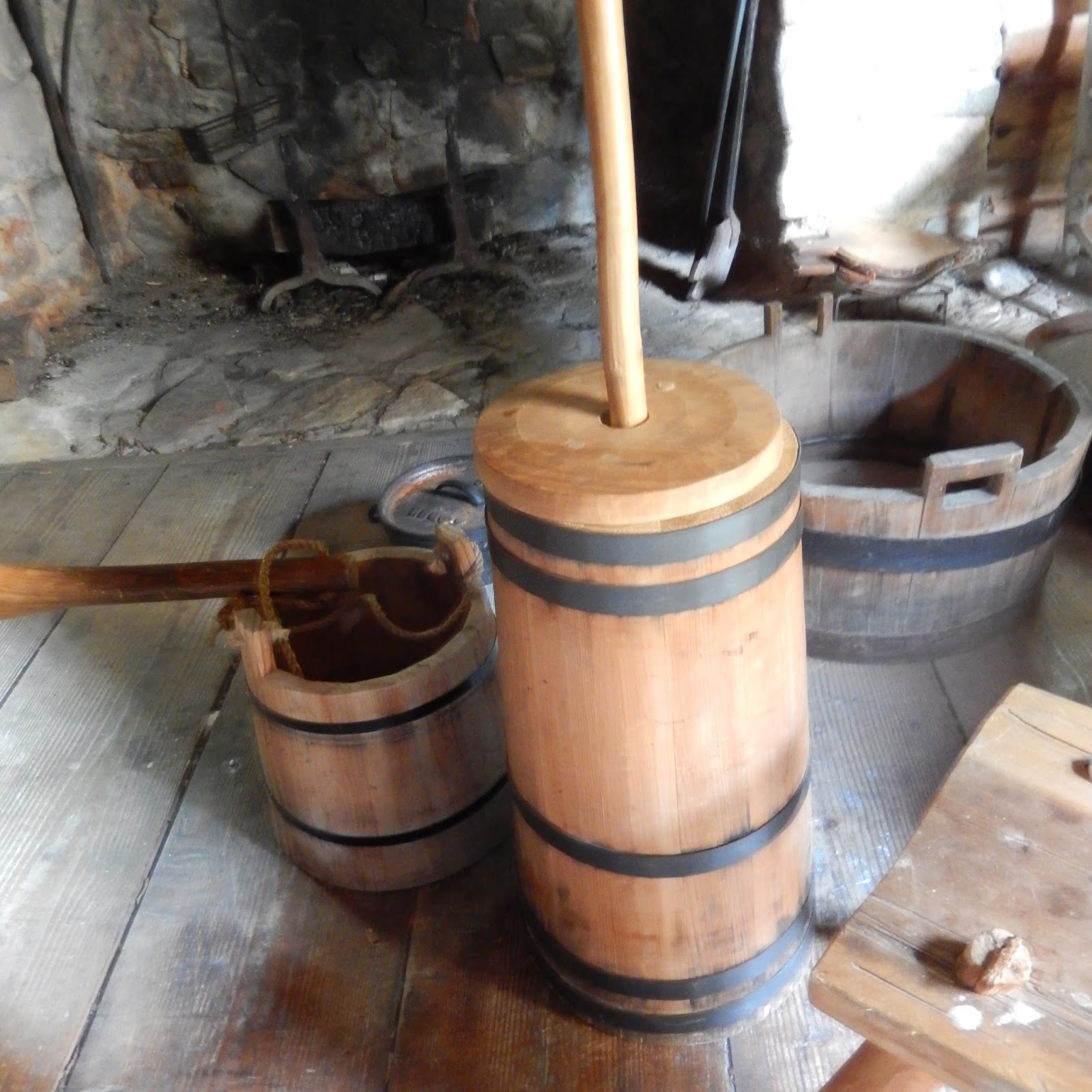
Fresh from the Churn

A few people still remember fresh butter and buttermilk from home churning. The ones from a store never have quite the same taste. But, since people don't keep milk cows much anymore, except for commercial milking, it's hard to find milk to churn.

There's actually many different styles of churns, and they're still sought after by antique collectors and those interested in early American decor. The most common kind of churn resembles a large crock and is made from pottery. This is the kind my mother had. But even in these, there's different colors, sizes, and styles.

Some churns had a crockery lid to match with a hole cut for the dasher. Others had a wooden lid to go with the wooden dasher. However, there were also wooden churns, as well as attachments that went on a large glass jar to make them into a churn. Of course, with a glass jar, one didn't need an attachment. Just put in the skimmed cream, screw on the lid tightly, and rock it back and forth until butter forms.


rare rocker churn
For the most part, churns have become things of the past. But, families who have one usually hang on to them. They tell of simpler times, when many families survived on what they had or could make. They're a part of our history.
______________________________________

Tuesday, September 8, 2015

James White Fort

I know I'm probably going to enjoy visiting a historic site that has more than 10,000 visitors a year. That certainly held true for James White Fort in Knoxville, where Knoxville was born. It was established in 1786, when the area was still part of the western frontier.


James White had been born in 1747 in Rowan County, North Carolina. In 1783, he led an expedition into the upper part of the Tennessee Valley, where the fort was eventually established. The fort became the capital of the Southwest Territory in 1790, which encouraged growth. White settled on a 1,000 acre land grant and donated land for the city of Knoxville in 1791. White died on August 14, 1821, and was buried beside his wife at the First Presbyterian Church Cemetery in Knoxville.

Today, visitors can tour the fort and White's first home. It's rare that one finds buildings and artifacts representing the 18th century this far west. It truly felt like a step back in time.

James White Fort
205 East Hill Avenue
Knoxville, NC 37915

865-525-6514

http://www.jameswhitesfort.org


_________________________________________